
Dental Clinic Service Prices in Saudi Arabia: Understanding the Factors That Determine Final Cost
Dental clinic service prices in Saudi Arabia vary rather than follow a single fixed value, and they should be interpreted according to treatment scope and the requirements of the patient’s case. Treatment cost depends on what the service includes and what is needed to carry out the treatment plan appropriate to the case. The final cost may vary when treatment scope differs or its requirements change.
A quote or advertised price may represent an initial amount associated with a specific service scope and does not necessarily mean it is the final amount due. The final cost may change if the patient’s case is found to require additional components or procedures that were not included in the initial price. When moving from understanding cost to finding available options, the Dental clinic directory in Saudi Arabia provides broader context for discovering clinics. Price remains most useful when interpreted in light of treatment scope and its conditions, rather than as an independent indicator of service quality.
Factors That Determine the Cost of Dental Clinic Services
The factors that determine the cost of dental clinic services are interconnected attributes that can change treatment scope or the treatment resources required and, in turn, affect the cost of dental services. These categories include service type and treatment scope, case complexity, materials and technologies, the number of sessions and follow-up, and tests. These factors do not necessarily operate separately, because treatment requirements may change when more than one factor is present in the same case. The factors affecting cost can be organized according to the part of the service scope or the resources needed to deliver it that they change:

- Service type and treatment scope: Determine which procedures the service includes and which resources it requires.
- Case complexity: May change treatment requirements and the resources needed to manage the case.
- Materials and technologies: May affect the resources used, including laboratory-related resources when needed.
- Number of sessions and follow-up: May change the duration of service delivery and the resources associated with completing treatment.
- Tests: May add requirements related to examination, X-rays, or assessment procedures to the service scope and billing.
No single factor carries a fixed weight in every case, because the effect of each category changes according to service type, treatment scope, and case requirements. Even when the service name is similar, the total cost may differ if case complexity, materials and technologies, the number of sessions, or required tests differ. These categories are used as a framework for understanding how cost is formed, while the effect of each factor depends on the treatment context itself.
How Cost Varies by Service Type and Treatment Scope
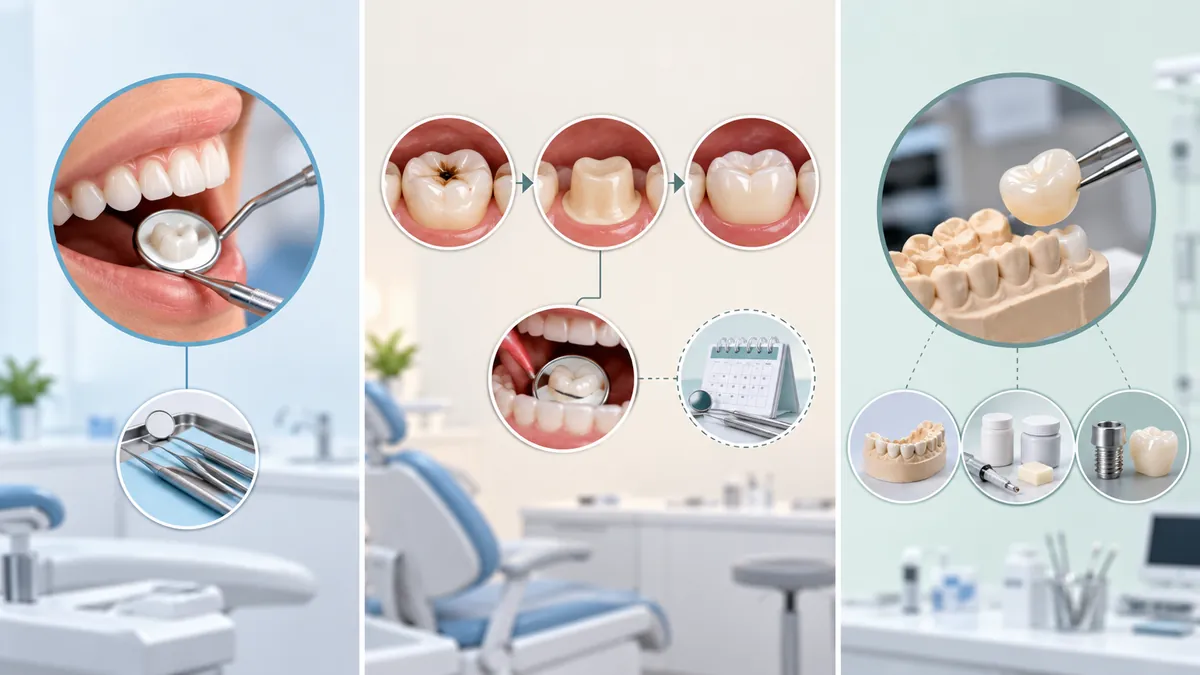
The cost structure varies by service type because treatment scope may require different procedures, stages, and resources. Some service patterns may be limited to a single stage, while others may include multiple stages or additional components. Cost should be interpreted by comparing the required procedures and treatment stages within an equivalent scope. The following representation shows how service scope may differ in terms of stages, possible components, and follow-up.
| Service pattern | Procedure scope | Possible additional components | Cost implication |
|---|---|---|---|
| Single stage | Procedure within a limited scope | May not require additional components | Cost is tied to the procedure scope and the resources included in it |
| Multiple stages | Procedures distributed across more than one stage | May include follow-up between treatment stages | The cost structure changes according to the number of stages and the resources they require |
| Service supported by a laboratory or device | A procedure that may depend on components outside the scope of direct delivery | May include laboratory work, materials, devices, and follow-up | Cost may vary according to the components and resources included in the treatment scope |
Service categories differ in scope, so comparing their costs is not useful unless the comparison includes similar treatment components. See Dental clinic services to understand the scope of different categories and the procedures they may include. Treatment scope may include follow-up, laboratory work, materials, or devices depending on the service and its requirements, which can change the cost structure. Cost comparison is more meaningful when equivalent service scopes are compared rather than dissimilar treatment categories.
Dental Condition and Degree of Treatment Complexity
The same general service may require a different treatment scope when the dental condition or degree of treatment complexity differs based on professional assessment. Simpler cases may need a limited scope of procedures and resources, while more complex cases may require additional stages or requirements. The service name alone is not enough to determine the amount of work required or interpret the related cost. The following representation shows the general relationship between case complexity and treatment scope without assuming a fixed treatment pathway.

Case complexity can affect the number of procedures, treatment stages, or resources included in the service scope and, in turn, the cost structure. During the examination, treatment requirements that could not be identified from the general service description may become apparent, so estimating the actual scope depends on assessment of the individual case. Greater complexity does not automatically mean a particular procedure or a fixed increase in cost, because requirements vary according to the case and the treatment plan appropriate to it. The effect of complexity on cost should be interpreted through professional assessment and the actual scope of work required.
Materials and Technologies Used and Their Effect on Cost
The materials and technologies used, together with devices, laboratory work, and the workflow associated with the technology, are possible inputs into the cost of delivering treatment. Different materials or devices may require different resources, and some treatment requirements may include laboratory work or extra workflow steps. Cost can be affected by the resources, time, and implementation stages required by a material or technology, rather than by the service name alone. The following representation shows groups of resources that may contribute to cost, without ranking materials or technologies by quality or suitability.

- Materials: Materials may differ in their use requirements and the resources involved in delivering treatment, which can be reflected in cost.
- Devices: Delivering some services may require a device or resources associated with it, which may form part of the cost structure.
- Laboratory work: Some treatment requirements may involve a laboratory or components produced outside the direct workflow within the clinic, which may add a resource to the service and its cost.
- Technologies and workflow: The technology used may change implementation steps, resources, or required time, so it can affect cost according to case requirements.
A higher resource cost does not necessarily mean better clinical suitability; resource requirements, workflow, and suitability for the case are separate concepts. A material or technology may cost more because of resources, laboratory work, or implementation requirements without that alone establishing clinical superiority or suitability for a particular case. Selection should be based on treatment requirements, suitability for the case, and relevant evidence, not on price as an independent indicator of quality.
Number of Sessions, Treatment Duration, and Follow-up Stages
The number of sessions, treatment duration, treatment stages, adjustments, and follow-up can affect the cost structure, but they do not determine cost on their own. The treatment plan determines the number of sessions, the types of visits, and whether treatment requires stages, adjustments, or follow-up. The effect of these elements on cost depends on treatment scope and what each stage or visit includes.
Follow-up may be included within the service scope, while in other cases it may be billed as a separate service, so it is necessary to verify what the quoted estimate includes. A higher number of visits also does not automatically mean a similar increase in cost, because some visits may be part of treatment stages or adjustments specified in the treatment plan; the following representation shows one possible illustrative pattern for these elements rather than a standard schedule. Likewise, treatment duration may differ without the number of sessions alone being a sufficient measure of the scope of work or total cost. A uniform number of sessions or treatment duration should not be assumed for all patients or services.

Does the Examination Fee Include X-rays and Tests, or Are They Charged Separately?
X-rays and tests may be included in the examination fee, or each may be charged separately, depending on the clinic, the scope of the offer, and the type of assessment required. The examination fee alone does not necessarily mean that the consultation, diagnosis, and all assessment components are included in the same billing. The following representation shows possible components of an examination visit whose inclusion should be verified.

The examination fee may cover consultation and examination within the specified scope, while X-rays or tests needed for diagnosis may be included in the quote or charged separately according to what the assessment requires. Other assessment components may also be associated with the visit and should be distinguished from consultation fees when interpreting the quote. The following cases show what should be verified for each component and do not represent a uniform billing rule. The scope of the examination fee should be verified, including whether X-rays, tests, and any other assessment components are included or separate, before interpreting the cost.
| Component | What to verify | Possible billing status |
|---|---|---|
| Consultation and examination | Whether the price covers the consultation and examination during the visit | May be included in the specified examination fee |
| X-rays | Whether the required imaging falls within the examination fee | May be included or charged separately |
| Diagnostic tests | Whether tests required for diagnosis are included in the offer | May be included or charged separately depending on the scope of the assessment |
| Other assessment components | Whether there are assessment-related components not included in the examination fee | May fall within the scope or be billed separately |
Difference Between the Service Price and Final Treatment Cost
The service price differs from the initial estimate and the final cost in terms of treatment scope, the information on which each type of price is based, and its degree of certainty. The advertised price usually reflects a service scope and components specified in the offer, while the initial estimate is based on the information available when it is prepared. The final cost reflects the treatment scope and included components after the requirements actually involved in treatment become clear. Comparing these states helps distinguish what each amount represents instead of treating them as the same kind of value.
These states also differ in the amount of information available and in any exclusions or unresolved components that may remain when the amount is set. The initial estimate may change when the assessment reveals additional procedures or requirements that were not known when the quote was prepared, while the degree of certainty depends on how clearly the treatment scope and included components are defined. The final cost may be affected by additional procedures or follow-up that actually enter the treatment when they are within the required scope and were not previously included. The differences can be summarized on a common basis of scope, information, degree of certainty, and what may change the amount:
| Price type | What it reflects | Degree of certainty | What may change the amount |
|---|---|---|---|
| Advertised price | Service scope and components specified in the offer | Depends on how clearly the offer states what it includes and its limits | Components or exclusions outside the scope of the advertised price |
| Initial estimate | Expected treatment scope based on the information available at the time of the estimate | May change depending on the completeness of assessment information and treatment requirements | The emergence of additional requirements or procedures that change treatment scope |
| Final cost | The amount associated with the treatment scope and components actually included in the service | Higher once the actual treatment scope and included components become clear | Any actual change in treatment scope or its components before the amount is finalized |
A fair price comparison requires an equivalent treatment scope, because differences in included components or procedures make comparing amounts alone insufficient to explain the difference. When expanding the comparison from cost to other selection criteria, How to compare dental clinics helps place price in a broader context without treating it as a standalone criterion. The quote and cost should be compared on the basis of an equivalent treatment scope, not by ranking clinics according to the amount.
When Is a Price Initial or Estimated?
A price is initial or estimated when not all information needed to determine treatment scope and included components is yet available. An initial estimate may be provided before the examination or X-rays are complete or before treatment requirements are finalized, so its degree of certainty is tied to what is known about the case when the estimate is prepared. As long as some treatment requirements remain unresolved, the amount may be adjusted according to what the assessment reveals.
An estimate may become more specific after the information needed to clarify treatment scope is complete, but that does not mean every estimated amount will change or that all cost elements are unknown. Some included components may have a clearly specified price, while others remain linked to the assessment result or to requirements that emerge while the treatment plan is being defined. It is necessary to verify what the initial estimate is based on, what it includes, and what could cause the amount to change before treating it as representative of the final cost.
Preparatory or Additional Procedures That May Change Cost
Preparatory or additional procedures are actions that may expand the original treatment scope when they are clinically required and are not already included in the base service. The need for them may arise before, during, or after the main procedure according to case requirements and the treatment plan. When these procedures add work or resources to the service scope, they may affect the final cost.
Functional additions may include diagnostic preparation needed to determine treatment requirements, preliminary treatment that must be completed before the base service, an additional procedure that becomes necessary while the plan is being carried out, or follow-up that forms part of completing treatment. This does not mean every patient will need these components, because their necessity depends on the assessment and case requirements. If an additional procedure is not included in the agreed scope and expands treatment scope, it may result in a change to the final cost. The included components should be verified, along with whether any required preparatory or additional procedures will be included in the quote or charged separately.
How to Understand a Dental Treatment Quote
A dental treatment quote should be understood as a statement tied to a specific treatment scope, not merely as a total amount that can be interpreted separately from its components. Reading the quote starts by identifying the treatment it represents, then understanding how the amount is defined, then distinguishing the assumptions or exclusions that affect the degree of certainty. The goal is to know what is currently specified and what may change after the assessment is complete, rather than accepting or rejecting treatment on price alone.
- Identify treatment scope: First verify the service or treatment covered by the quote, because the meaning of the amount depends on the scope it represents.
- Check how the amount is defined: Distinguish whether the amount is a specified price for a known scope or an estimate based on the information available at this stage.
- Review assumptions and exclusions: Identify what the quote assumes and what may not be included in the scope, because this affects interpretation of the amount and its degree of certainty.
- Separate what is known from what may change: Distinguish components known when the quote is prepared from requirements that may become clear or change after assessment.
In this way, reading a quote becomes a process of understanding the relationship between treatment scope, the amount, and the available information instead of comparing the number alone. The estimate may change when the information changes or when it becomes clear that treatment scope requires components or procedures that were unresolved when the quote was prepared. Any possible change should be interpreted in light of what changed in the scope or information, while details of individual components and cost-specific verification questions are addressed in the following sections.
A quote alone does not determine whether treatment is suitable for the case or the quality of the clinical decision. Price describes a financial aspect within a defined scope and set of information, while interpretation of the treatment itself depends on its requirements and suitability for the case. The most accurate reading of the quote is to understand what the amount represents now, which assumptions it is based on, and what may change after the assessment.
Services, Materials, and Stages Included in a Quote
A quote is a set of priced or described components that together form the offered treatment scope. These components begin with the base service and its related treatment items, while indicating whether other elements are within the scope or remain unspecified. Distinguishing a stated component from an unspecified component clarifies what can be considered included according to the details of the quote itself.
When reviewing a quote, identify the base service and the procedures associated with it, then determine whether relevant materials, devices, or laboratory work are stated in the details when they apply to the treatment. The quote should also state the status of examinations, treatment stages, and follow-up when they are part of its scope, rather than assuming their inclusion from the service name alone. Linking each component to its stated status helps separate what is clearly specified from what remains unspecified or needs clarification.
| Component | What the quote should clarify | Inclusion or specification status |
|---|---|---|
| Base service | The service represented by the quote and its described scope | Included when clearly stated within the quote scope; otherwise the scope remains unspecified |
| Associated procedures | Procedures associated with the base service that are covered by the price | Inclusion is determined by the procedures explicitly stated; an unstated procedure should not be assumed to be included |
| Materials and devices | Materials, devices, or laboratory work related to the treatment when applicable | Their status is specified if the quote states that they are included in the price or separated from it; otherwise they remain unspecified |
| Tests | Tests included in the treatment or assessment scope when needed | They may be included or separate according to what the quote states; not mentioning them does not establish that they are included |
| Treatment stages | The stages covered by the offered scope and whether the price relates to one specified stage or more | The scope is clear when the quote specifies the included stages; unstated stages remain unspecified |
| Follow-up | Whether follow-up visits or procedures are within the quote scope when related to the treatment | Follow-up is included only to the extent specified by the quote; otherwise its inclusion status remains unspecified |
Questions That Clarify What the Price Includes and What May Change During Treatment
Cost questions help verify what the price includes, what is charged separately, and what may lead to a change in cost during treatment. The quote should also clarify whether the price is fixed or estimated and whether follow-up is within the scope.
- What exactly does the price include, and which items are charged separately from the quote?
- Is the price fixed or estimated, and what information or treatment circumstances could lead to a change in cost?
- Is treatment-related follow-up included in the price, or may it involve an additional cost?
- If treatment scope changes or an additional cost arises, how is the quote updated and how is the patient informed of the change?
These questions reduce ambiguity because they distinguish included and separate items and clarify the circumstances of change and how the quote is updated and the patient is informed of the revised cost. These questions remain limited to pricing clarification; checking broader aspects related to the visit falls under What to ask before booking.
Insurance Coverage for Dental Clinic Services in Saudi Arabia
Health insurance can affect the amount the patient pays for dental services, but it does not guarantee coverage for every dental service. Dental coverage depends on the terms of the insurance policy and whether the eligible service falls within the scope of coverage. Insurance coverage can change the patient’s treatment cost according to the applicable terms without meaning that the full cost is covered.
The insurance policy defines the scope of dental coverage and the terms for an eligible service, including any exclusions that may apply. Coverage may be affected by the provider’s status within the provider network and by any claim-related conditions. Some services may also require prior authorization if the policy terms state this. Coverage limits, together with any coinsurance or uncovered amount, affect the portion of the cost paid by the patient. The actual policy terms, including eligibility, network status, prior authorization, coverage limits, and exclusions, should be verified rather than relying on general assumptions.
Which Dental Services May Be Covered and What May Be Excluded?
A service may be covered, partially covered, or excluded from coverage depending on the terms of the specific insurance policy. The service’s eligibility and the coverage status applied to it should be verified instead of assuming that a particular dental service always falls into one status.
Under an insurance policy, a service is treated as one of three coverage states: covered, partially covered, or excluded, depending on the terms that apply to it. The following states explain what each status means and what should be verified without assuming a uniform list of included or excluded dental services. The actual status depends on service eligibility, its conditions, and the applicable coverage limits. These elements should be checked in the policy for the service before its status is determined.
| Coverage status | What it means | What to verify |
|---|---|---|
| Covered | The service is treated as eligible for coverage under the applicable policy terms. | Service eligibility and the terms that apply to its coverage. |
| Partially covered | The policy may cover part of the service according to the applicable terms and coverage limits. | Coverage limits and the terms affecting the scope of the covered portion. |
| Excluded | The service is treated as outside the scope of coverage when the exclusions specified in the policy apply to it. | The wording of the exclusion and the conditions for applying it to the specified service. |
How Do Coverage Limits and the Patient’s Share Affect Final Cost?
Coverage limits affect the final cost because they determine how much of the eligible service cost the insurance policy can cover, while the patient’s share represents the portion that remains payable by the patient under the policy terms. A covered service does not mean that coverage will equal the full treatment cost, because coverage limits, coinsurance, and any uncovered portion may affect the amount due. The actual effect is determined after the coverage terms are applied to the service and its cost.
An insurance policy may set a financial limit or terms that determine the amount of coverage available for a service, and once the limit is reached, part of the cost may remain outside the covered amount. Coinsurance may also define the portion the patient shares in paying under the applicable terms, while any uncovered amount is added to the patient’s financial responsibility when applicable. A single percentage or limit cannot be used to calculate the final cost in all cases, because the method of application depends on the insurance policy, the eligible service, and its specific coverage terms. Coverage limits, coinsurance, and any uncovered amount should be verified to determine the amount the patient actually pays.